<?xml version="1.0" encoding="utf-8"?><feed xmlns="http://www.w3.org/2005/Atom" ><generator uri="https://jekyllrb.com/" version="4.3.4">Jekyll</generator><link href="https://inthefourthnocturn.de/feed.xml" rel="self" type="application/atom+xml" /><link href="https://inthefourthnocturn.de/" rel="alternate" type="text/html" /><updated>2026-03-02T20:20:44+00:00</updated><id>https://inthefourthnocturn.de/feed.xml</id><title type="html">In the Fourth Nocturn</title><subtitle>Church things.</subtitle><author><name>Daphne Preston-Kendal</name></author><entry><title type="html">On a disappointing response by the Roman Catholic Church</title><link href="https://inthefourthnocturn.de/2024/02/gentili/" rel="alternate" type="text/html" title="On a disappointing response by the Roman Catholic Church" /><published>2024-02-18T13:20:09+00:00</published><updated>2024-02-18T13:20:09+00:00</updated><id>https://inthefourthnocturn.de/2024/02/gentili</id><content type="html" xml:base="https://inthefourthnocturn.de/2024/02/gentili/"><![CDATA[<p>This week the trans activist Cecilia Gentili was commemorated in a
Catholic funeral service at St Patrick’s Cathedral in New York. The
service, intended as a requiem mass, was cut short by the allegedly
unacceptable behaviour of mourners in attendance.</p>
<p>The incident quickly became a <i lang=fr>cause célèbre</i> for
American reactionary conservatives and their outrage-mongers. They
misgendered Gentili; they said that she was an atheist and a prostitute
and should therefore not have been given a church burial. Most
foolishly, they asserted that those at the funeral who celebrated ‘Saint
Cecilia’ thereby defamed the memory of Cecilia of Rome, Virgin and
Martyr, rather than taking from it what was surely intended — to
commemorate Gentili herself as sacred.</p>
<p>The cathedral’s clergy <a
href="https://www.msn.com/en-us/news/us/archdiocese-of-new-york-condemns-funeral-for-transgender-activist-cecilia-gentili-at-st-patricks-cathedral/ar-BB1is8cN">responded</a>
by joining in the blanket condemnation of the service they had held,
calling it ‘sacrilegious’ and inappropriate to the season of Lent;<a
href="#fn1" class="footnote-ref" id="fnref1"
role="doc-noteref"><sup>1</sup></a> they assure us that they have
offered a Mass of Reparation to atone.</p>
<p>The cathedral’s response is disappointing inasmuch as by failing to
respond to any specific criticism of the events, they implicitly condone
all of these arguments. They said nothing of the circumstances of
poverty in which Gentili found herself with no other option but sex work
upon moving to New York; they said nothing of her work campaigning
against the unjust laws which persecuted her and many other trans women.
They failed to note that, as a baptized Catholic, she was eternally
bound to the body of Christ and had as much right to a church burial as
any other Catholic.<a href="#fn2" class="footnote-ref" id="fnref2"
role="doc-noteref"><sup>2</sup></a> They did not correct those who
referred to her as male. Moreover, in defending themselves with the
claim that they knew nothing about the person whom they were burying,
they hold the deceased Gentili for the behaviour of the mourners at her
funeral.</p>
<hr />
<p>Nonetheless, the cathedral’s naïveté here should nonetheless be a
lesson to itself — of a rather different kind.</p>
<p>As it was burying a well-known trans and sex workers’ rights
activist — well-known enough to enjoy a detailed biography on
Wikipedia — the cathedral should have expected a large number of trans
people and sex workers would wish to attend to pay their respects. The
cathedral should have recognized that many of the mourners would thus be
guests in a Christian church to which they do not belong — a Church
which has hurt many of them.</p>
<p>In this context the Church must realize that it is playing host to a
different culture and act in accordance with God’s commandment to
hospitality. It must hold fast to its traditions and doctrines while
welcoming those of the community it invites into its House. But in this
specific context, it must also reflect on what it has done in the past
to hurt the people of that community; what it has done to make itself
the object of mockery by them.</p>
<p>This is not to say it should take this mockery lying down (nor that a
funeral is the right context for a theological debate over the Church’s
past treatment of trans people and sex workers). But to preach the
message of Christ to all means also to seek forgiveness from those whom
the Church has hurt by allowing a twisted version of that message to be
sent out. This perversion of the gospel may not have come from the Roman
Catholic Church itself, but the reaction from American conservatives
shows how little the universal message of reconciliation is understood
even among those who seem to think they stand with the Church.</p>
<p>This moment should have been an opportunity for the Church to teach
and to learn; the Church wasted it by appeasing those who twist the word
of Christ to mean unforgiveness and hate.</p>
<section id="footnotes" class="footnotes footnotes-end-of-document"
role="doc-endnotes">
<hr />
<ol>
<li id="fn1"><p>Had she only been so considerate as to wait until Easter
to die!<a href="#fnref1" class="footnote-back"
role="doc-backlink">↩︎</a></p></li>
<li id="fn2"><p>Wikipedia notes that Gentili was, in November last year,
‘exploring her relationship to religion’; it is not unreasonable to
suppose that she had returned to faith by the time of her death. It is
certainly hard to believe that her family and friends would have
requested a ‘funeral Mass for a Catholic’ if she were still an ‘avowed
atheist’.<a href="#fnref2" class="footnote-back"
role="doc-backlink">↩︎</a></p></li>
</ol>
</section>]]></content><author><name>Daphne Preston-Kendal</name></author><summary type="html"><![CDATA[This week the trans activist Cecilia Gentili was commemorated in a Catholic funeral service at St Patrick’s Cathedral in New York. The service, intended as a requiem mass, was cut short by the allegedly unacceptable behaviour of mourners in attendance.]]></summary></entry><entry><title type="html">New: Lectionary booklets</title><link href="https://inthefourthnocturn.de/2021/11/lectionary-booklets/" rel="alternate" type="text/html" title="New: Lectionary booklets" /><published>2021-11-21T08:45:38+00:00</published><updated>2021-11-21T08:45:38+00:00</updated><id>https://inthefourthnocturn.de/2021/11/lectionary-booklets</id><content type="html" xml:base="https://inthefourthnocturn.de/2021/11/lectionary-booklets/"><![CDATA[<p><strong>Synopsis:</strong> <a
href="https://dpk.gitlab.io/lectionary-booklets/">Lectionaries!
Lectionaries! Get your lectionaries here!</a></p>
<hr />
<p>For the last few years my preferred table of lessons for the daily
office has been the one published by the Church of England in 1961 — a
slight revision of the 1922 lectionary found at the front of current
editions of the <cite>Book of Common Prayer</cite>. Like the 1922
lectionary, it is based on the Church year, not the civil calendar year;
but it has the following advantages, especially felt in private
devotion, over the original:</p>
<ul>
<li>A two-year fixed cycle of Sunday lessons, instead of the free choice
of up to three lessons provided by the 1922 lectionary. It might well be
realistic for a parson to read all the available options in the 1922 and
pick the most appropriate to read at a public service of Mattins or
Evensong; when praying privately, one is in practice hamstrung into
picking a reading knowing nothing more than the book and chapter,
usually picking the first one by default. The 1961’s provision of a
two-year cycle on Sundays only is a marked improvement for those who
pray the office alone or in small, informal groups. (On the most
important days, such as Advent Sunday, Septuagesima, Easter, etc., the
significant readings are the same in both years.)</li>
<li>The elimination of ‘gospel harmony’ after Trinity in favour of
straightforward <i lang=la>lectio continua</i> reading of the synoptics,
eliminating a lot of back-and-forth switching between the gospels.</li>
</ul>
<p>However, getting a copy of this lectionary is rather tricky, as it
was effectively out of print until recently. John Hunwicke includes it
in his Ordo every year; I included it in my office book in 2019; but
more recently the <a
href="https://www.ivpress.com/the-1662-book-of-common-prayer">1662
<cite>Book of Common Prayer</cite> International Edition</a> has
included most of it in an appendix as an ‘alternative table of lessons’,
somewhat reviving interest in it.</p>
<p>Since I usually carry around and pray from a 1662 pew edition,
though, none of these solutions are very convenient. So I’ve made <a
href="https://dpk.gitlab.io/lectionary-booklets/">little A6 booklets</a>
to slip inside my prayer book, containing the lectionary in worked-out
form for each Church year. Maybe you’ll find them useful too!</p>]]></content><author><name>Daphne Preston-Kendal</name></author><summary type="html"><![CDATA[Synopsis: Lectionaries! Lectionaries! Get your lectionaries here!]]></summary></entry><entry><title type="html">Ave maris stella</title><link href="https://inthefourthnocturn.de/2021/03/ave-maris-stella/" rel="alternate" type="text/html" title="Ave maris stella" /><published>2021-03-25T09:11:00+00:00</published><updated>2021-03-25T09:11:00+00:00</updated><id>https://inthefourthnocturn.de/2021/03/ave-maris-stella</id><content type="html" xml:base="https://inthefourthnocturn.de/2021/03/ave-maris-stella/"><![CDATA[<figure>
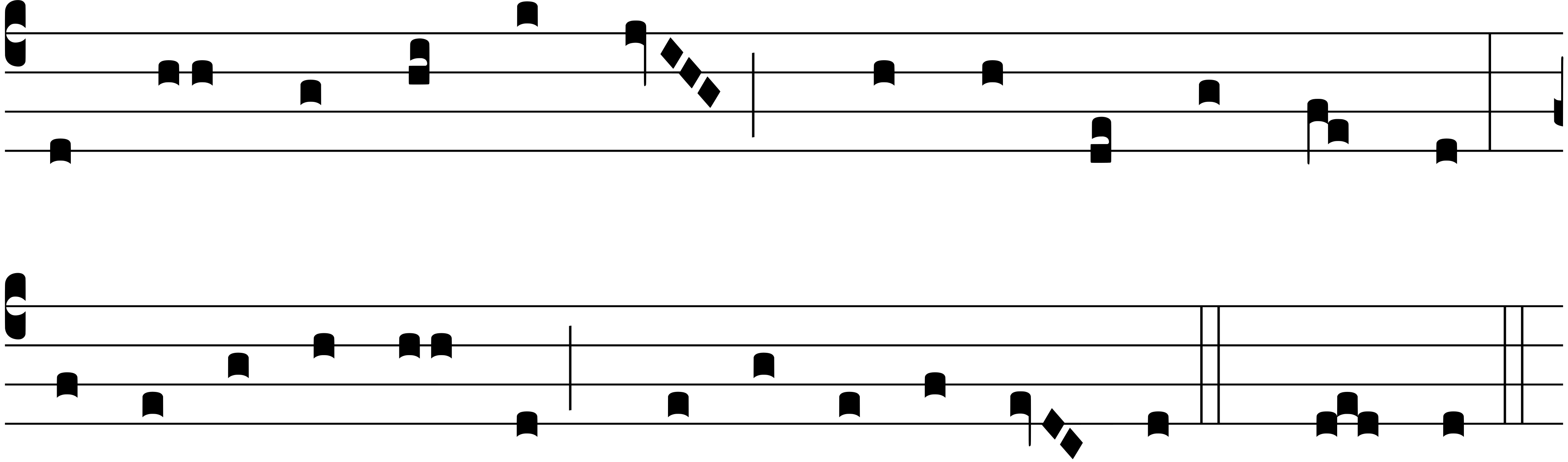
<img src="/img/ave-maris-stella.svg" style="width:100%">
</figure>
<ol type="1">
<li><p><i lang=la>Ave, maris stella,</i><br />
God’s own Mother, loving,<br />
<i lang=la>atque semper virgo,</i><br />
blessed gate of heaven.</p></li>
<li><p><i lang=la>Sumens illud «Ave»</i><br />
Gabr<i>i</i>el’s word was spoken.<br />
Guard in peace our pathways,<br />
<i lang=la>mutans Evae nomen.</i></p></li>
<li><p><i lang=la>Solve vincla reis,</i><br />
healing light revealing,<br />
<i lang=la>mala nostra pelle,</i><br />
for us interceding.</p></li>
<li><p><i lang=la>Monstra te esse matrem,</i><br />
to him praying humbly,<br />
<i lang=la>quem pro nobis natum</i><a href="#fn1" class="footnote-ref"
id="fnref1" role="doc-noteref"><sup>1</sup></a><br />
him who made thee holy.</p></li>
<li><p><i lang=la>Virgo singularis,</i><br />
meek beyond comparing,<br />
<i lang=la>nos culpis solutos,</i><br />
make us meek and caring.</p></li>
<li><p><i lang=la>Vitam praesta puram,</i><br />
watch the way before us,<br />
that, <i lang=la>videntes Jesum,</i><br />
we may join his chorus.</p></li>
<li><p><i lang=la>Sit laus Deo Patri,</i><br />
as to Christ in heaven,<br />
<i lang=la>Spiritui Sancto</i><br />
triune praise be given. Amen.</p></li>
</ol>
<section id="footnotes" class="footnotes footnotes-end-of-document"
role="doc-endnotes">
<hr />
<ol>
<li id="fn1"><p>There are a number of cases in Latin which might work
here, since the verb is in English, but the original nominative does
not.<a href="#fnref1" class="footnote-back"
role="doc-backlink">↩︎</a></p></li>
</ol>
</section>]]></content><author><name>Daphne Preston-Kendal</name></author><summary type="html"><![CDATA[]]></summary></entry><entry><title type="html">Was the catholic party to blame for the failure of the 1928 prayer book?</title><link href="https://inthefourthnocturn.de/2021/01/1928-catholic-failed/" rel="alternate" type="text/html" title="Was the catholic party to blame for the failure of the 1928 prayer book?" /><published>2021-01-01T14:30:09+00:00</published><updated>2021-01-01T14:30:09+00:00</updated><id>https://inthefourthnocturn.de/2021/01/1928-catholic-failed</id><content type="html" xml:base="https://inthefourthnocturn.de/2021/01/1928-catholic-failed/"><![CDATA[<p><i>This is a rather scrappy post which I saved out of a draft Twitter
thread that contained too many arguments that I couldn’t quite squeeze
into 280 characters. Apologies for loose reasoning, lack of citation,
etc.</i></p>
<hr />
<p>I’m considering the view that it was, in fact, mainly the catholic
party which was primarily responsible for the failure of the 1928 prayer
book — even the more moderate catholics who actually supported the
book’s passage (and not just the extreme ‘Romanizers’ who rejected it on
the grounds that neither it, nor the 1662 before it, were sufficiently
doctrinally orthodox in their view).</p>
<p>The 1928 book was really the result of a failure to compromise. Or
rather, it made one lazy compromise: for the first time, it would have
officially sanctioned liturgical disuniformity in the name of letting
everyone use the form of service they liked most. We can see the
disaster this attitude has got us into today; at the time, the provision
allowing the 1662 book to continue in use exactly as it was must have
made it seem less necessary for the (largely catholic-leaning)
reformists to find single forms of worship acceptable to all parties in
the church. Those unhappy with any particular changes could simply
ignore them.</p>
<p>If the moderate (Dearmerian) catholic party had been more willing to
accept compromise, work for liturgical unity, and make a single,
completely reformed <cite>Book of Common Prayer</cite>, perhaps it would
have succeeded. The whole ‘additions and deviations’ approach was as
much to blame for the book’s failure than objections to any of the
individual ‘deviations’ allowed.</p>
<p>There were a lot of small, uncontroversial improvements to the 1662
book which could have been made without needing to keep old forms
around. The 1928 could have been what the 1662 was to previous BCPs: an
unquestionable, if minor, improvement with no doctrinal controversy.
Improvements like: a shorter daily office, especially for weekdays; new
prayers and thanksgivings; more eucharistic propers; and the subtle
updating of outdated wording (e.g. changing ‘vile body’ to ‘body of our
low estate’ in the burial service).</p>
<p>The most doctrinally controversial aspects of the new book were the
provision for reservation and the long eucharistic prayer of the new
communion service. Obviously, nearly a century later, I can’t say what
compromises might have worked in these areas to yield agreement between
the catholics and evangelicals of the 1920s. But, say, if the moderate
catholics had given up on allowing reservation, then the other changes
in the communion service (dropping the decalogue, shorter confession and
absolution, etc.) would alone have significantly decreased the
difficulty of celebrating in multiple patients’ homes in a short period
of time. As far as I have read, even after the second defeat of the
revised book in 1928, simply trying to get the measure through a third
time and removing the provision for reservation altogether was seemingly
never seriously considered.</p>]]></content><author><name>Daphne Preston-Kendal</name></author><summary type="html"><![CDATA[This is a rather scrappy post which I saved out of a draft Twitter thread that contained too many arguments that I couldn’t quite squeeze into 280 characters. Apologies for loose reasoning, lack of citation, etc.]]></summary></entry><entry><title type="html">Low Sunday</title><link href="https://inthefourthnocturn.de/2020/04/low-sunday/" rel="alternate" type="text/html" title="Low Sunday" /><published>2020-04-19T09:26:32+00:00</published><updated>2020-04-19T09:26:32+00:00</updated><id>https://inthefourthnocturn.de/2020/04/low-sunday</id><content type="html" xml:base="https://inthefourthnocturn.de/2020/04/low-sunday/"><![CDATA[<p>Today is commonly called ‘Low Sunday’ in English. In German, it is
called <i lang=de>weißer Sonntag</i> – White Sunday. In English we have
our own White Sunday: Pentecost, or Whitsunday. The reasons for
associating the colour white with these two different days are probably
very different, but nonetheless there’s a connection between today and
Pentecost in the Gospel reading.</p>
<p>On Pentecost we celebrate the coming of the Holy Ghost to the
disciples after the ascension, as it is told by St Luke in the Book of
the Acts of the Apostles. In today’s reading, on the other hand, we hear
a similar story told in characteristically more mystical terms by
St John: Jesus giving the gift of the Holy Ghost to his disciples by his
own breath, after the resurrection but <em>before</em> the
ascension.</p>
<p>In today’s <a
href="https://www.churchofengland.org/prayer-and-worship/worship-texts-and-resources/book-common-prayer/collects-epistles-and-gospels-35">Epistle
and Gospel readings,</a> we see not only how Christ came to us, died,
and was resurrected, but that the Holy Spirit he gave us bears witness
to these things for us. We remember the resurrection we celebrated last
Sunday, but once again, as in Lent, we find ourselves driven to looking
forward — this time to the Ascension and to Pentecost.</p>
<p>Jesus says before he gives them the Holy Spirit, ‘As my Father hath
sent me, even so send I you.’ What extraordinary words. ‘In the same way
that my Father sent me, the eternal and divine Christ, to be become
human, and to bear witness to God in the world through ministry, and to
suffer for the sins of everyone else — in the same way as my Father sent
me for these things, that’s what I’m sending you to do.’ In the
narrative Jesus is speaking to his disciples, but this is his message to
us all, his Church. And then he gives them the Holy Ghost.</p>
<p>John tells us the significance of this gift in his Epistle. If we
have received the Holy Spirit, we live in truth. We bear witness to the
truth of Christ. Without the Spirit, we have no truth; without the
Spirit, we have no Christ in us, no resurrection in us, and no life in
us.</p>
<p>This is the significance of the forgiveness of sins. Sin means death.
Nine weeks ago, on the second Sunday before Lent, we heard in Genesis
chapter 3 the origin of sin, and how mankind, that God had destined for
immortality, rebelled against him by sinning. You had one job, Adam:
don’t eat from that tree. But he did. After that, everyone who followed
in the footsteps of Adam and Eve by sinning was doomed, like they were,
to die.</p>
<p>But knowing Christ gives us life. Knowing Christ, we inherit the
gifts that he gave us. He tells us that, if we forgive each others’
sins, they are forgiven. Just like that. One of the things the Pharisees
objected to about Jesus’s ministry was how he, a mere man, dared to
proclaim the forgiveness of sins. Only God can do that, they said. But
when we know Christ and accept the gift of the Spirit, we can all
forgive sin. We give each other the gift of eternal life and freedom
from death.</p>
<p>All of us suffer from sin. We suffer from doing sinful things. We
suffer from the sinful things other people do to us. Hell, as Jean-Paul
Sartre put it, is other people. As long as we have this sinful nature,
we will carry on hurting each other, and suffering from being hurt by
the sins of others – just as Christ suffered from the sins of his people
against him. But he forgave them, and gave them life. He gave us the
gift of life to share among ourselves.</p>
<p>When <a href="https://www.rmjs.co.uk/psalter/psalms.php?p=22">Psalm
22</a> came around in the daily office at the beginning of this month, I
shared a brief reflection on the contrast between the first part of it,
which is a clear prophecy of the crucifixion, and the second part, which
dramatically changes mood and points to praise and thanksgiving to God
for the resurrection. Good Friday, I said, is meaningless without Easter
Sunday. The crucifixion of one poor, itinerant Jewish preacher for
heresy would have been forgotten by history had he not shown himself to
be divine by rising from the dead three days later.</p>
<p>Today’s readings urge us on in a similar way. The resurrection of
Christ isn’t just an extraordinary miracle in and of itself, neither is
it just that it shows us what lies ahead of us when our own bodies pass
away. It points us to the Christian life on earth as well. It points us
to living by the guiding of the Holy Spirit to spread his gift among us.
If we let that gift guide us, it spreads among us — the most wonderful
gift of all.</p>
<hr />
<blockquote>
<p>Grant, we beseech thee, Almighty God, that the words, which we have
heard this day with our outward ears, may through thy grace be so
grafted inwardly in our hearts, that they may bring forth in us the
fruit of good living, to the honour and praise of thy Name — through
Jesus Christ our Lord. <em>Amen.</em></p>
</blockquote>]]></content><author><name>Daphne Preston-Kendal</name></author><summary type="html"><![CDATA[Today is commonly called ‘Low Sunday’ in English. In German, it is called weißer Sonntag – White Sunday. In English we have our own White Sunday: Pentecost, or Whitsunday. The reasons for associating the colour white with these two different days are probably very different, but nonetheless there’s a connection between today and Pentecost in the Gospel reading.]]></summary></entry><entry><title type="html">The time of approach</title><link href="https://inthefourthnocturn.de/2020/01/approach-18c/" rel="alternate" type="text/html" title="The time of approach" /><published>2020-01-16T15:23:35+00:00</published><updated>2020-01-16T15:23:35+00:00</updated><id>https://inthefourthnocturn.de/2020/01/approach-18c</id><content type="html" xml:base="https://inthefourthnocturn.de/2020/01/approach-18c/"><![CDATA[<p>Further to my <a href="/2020/01/draw-near/">previous article on the
time of approach to the altar to receive the holy communion,</a> a
careful Google Books search has provided me with two independent pieces
of evidence on 18th (and possibly 17th) century practice: one by William
Beveridge (1637–1708), Bishop of St Asaph, in his apparently
posthumously published book <a
href="https://books.google.de/books?id=fKg7AAAAcAAJ"><cite>The Great
Necessity and Advantage of Publick Prayer and Frequent
Communion</cite></a> (1709); and secondly a 1747 (eighth) edition of <a
href="https://books.google.de/books?id=NWZ04Rhn9bAC"><cite>The New
Week’s Preparation for a Worthy Receiving of the Lord’s
Supper.</cite></a></p>
<p>These texts suggest that the time of approach was even earlier than I
speculated in my previous article — not only before the prayer for
Christ’s Church, but before the offertory and the offertory sentences
themselves.</p>
<p>First, the earlier source, Beveridge’s <cite>Great Necessity,</cite>
presumably describing practices he had known throughout his life,
includes prayers for communicants to say privately at the service, in
this order: ‘Before going to the Altar’; ‘At going to the Altar’; ‘At
prostrating before the Altar’; ‘Whilst others are coming up, and the
Priest preparing to read the Sentences’; ‘At the Offertory’.</p>
<p>Second, the <cite>New Week’s Preparation</cite> provides a much more
detailed outline of preparation and prayer, starting the week before
reception and proceeding day by day, continuing smoothly into the
devotions to be made during the communion service itself. The section
immediately following a ‘prayer to be used as soon as Sermon is ended’
is a detailed annotated version of the prayer book liturgy from the
offertory onwards entitled ‘The Companion for the Altar’, beginning:</p>
<blockquote>
<p>Now, laying aside all <em>Fears</em> and <em>Despondencies</em>,
proceed to the <em>Communion Service,</em> and then to the
<em>Sacrament,</em> which as much Joy and Satisfaction, as a guilty
Criminal would go to plead his Pardon at an Earthly Tribunal.</p>
<p>☞ At your Approach in the <em>Chancel,</em> drop all Thoughts of
Things on Earth, and give up yourself wholly to the Remembrance of the
Sufferings of our Saviour, lifting up your Soul to him in these
Words:</p>
<blockquote>
<p>I will wash my Hands in Innocence, O Lord, and so will I compass thy
Altar, that I may shew the Voice of Thanksgiving, and tell of all thy
wonderous Works.</p>
</blockquote>
<p><em>Rubrick.</em></p>
<p>¶ Then shall the Priest return to the Lord’s Table (etc., rubric from
the prayer book)</p>
</blockquote>
<p>The movement of communicants from nave to chancel immediately after
the sermon may also explain the 18th century practice of
<em>non-</em>communicants leaving the church entirely after the
sermon.</p>
<p>The <cite>New Week’s Preparation</cite> also suggests that my
hypothesis that the communicants would remain in place for the prayers
of thanksgiving after reception is incorrect: the private devotion
entitled ‘A Prayer of <em>Thanksgiving</em> as soon as we are retired
from the Lord’s Table’ comes immediately after reception and before the
Lord’s Prayer. The rubrics are fairly clear that communicants should
withdraw at some point before the blessing,<a href="#fn1"
class="footnote-ref" id="fnref1" role="doc-noteref"><sup>1</sup></a> but
I had assumed this would be before or during the <i lang=la>Gloria</i>,
since the Lord’s Prayer and thanksgiving or oblation belong to the canon
and not the dismissal in the old mass. But if the approach before the
offertory is in any way a continuance of a mediaeval custom, it makes
sense that the communicants would have continued to withdraw at the
point in their own devotions at which they had always been accustomed to
(i.e., directly after receiving) notwithstanding that the
<em>content</em> of the prayers following reception had originally
belong to the part of the service they would have been in the chancel
for.</p>
<h1
id="when-did-the-modern-practice-of-approaching-after-the-consecration-arise">When
did the modern practice of approaching after the consecration
arise?</h1>
<p>An account of the <a
href="https://en.wikipedia.org/wiki/Robert_Walker_(priest,_of_Seathwaite)">Rev. Robert
Walker</a> (1709–1802) quoted by Wordsworth and <a
href="https://books.google.de/books?id=CNwEAAAAQAAJ&amp;pg=PA43">published
1820 in <cite>The Edinburgh Magazine</cite> reads</a> (emphasis
mine):</p>
<blockquote>
<p>There is a small chapel, in the county palatine of Lancaster, where a
certain clergyman has regularly officiated above sixty years, and a few
months ago administered the sacrament of the Lord’s Supper in the same,
to a decent number of devout communicants. <em>After the clergyman had
received himself, the first company out of the assembly who approached
the altar, and kneeled down to be partakers of the sacred elements,</em>
consisted of the parson’s wife, … (etc.)</p>
</blockquote>
<p>More precisely datable accounts doubtless exist, but as Walker was
appointed to the church of Seathwaite, Lancashire in 1736, and this
account apparently dates from a time when he had been serving his chapel
for over sixty years, apparently the modern practice was common enough
not to be surprising by 1796 or earlier, but practice may have varied
from church to church for significantly longer. Sources or further
information would be appreciated.</p>
<section id="footnotes" class="footnotes footnotes-end-of-document"
role="doc-endnotes">
<hr />
<ol>
<li id="fn1"><p>The rubric concerning disposal of the remaining
consecrated sacrament reads: ‘the Priest, and such other of the
Communicants as he shall then call unto him, shall, immediately after
the Blessing, reverently eat and drink the same’. But the priest would
not need to call the communicants back to him if they had remained
‘conveniently placed for the receiving of the holy Sacrament’.<a
href="#fnref1" class="footnote-back" role="doc-backlink">↩︎</a></p></li>
</ol>
</section>]]></content><author><name>Daphne Preston-Kendal</name></author><summary type="html"><![CDATA[Further to my previous article on the time of approach to the altar to receive the holy communion, a careful Google Books search has provided me with two independent pieces of evidence on 18th (and possibly 17th) century practice: one by William Beveridge (1637–1708), Bishop of St Asaph, in his apparently posthumously published book The Great Necessity and Advantage of Publick Prayer and Frequent Communion (1709); and secondly a 1747 (eighth) edition of The New Week’s Preparation for a Worthy Receiving of the Lord’s Supper.]]></summary></entry><entry><title type="html">Die Schönste von allen</title><link href="https://inthefourthnocturn.de/2020/01/die-schoenste-von-allen/" rel="alternate" type="text/html" title="Die Schönste von allen" /><published>2020-01-15T12:09:34+00:00</published><updated>2020-01-15T12:09:34+00:00</updated><id>https://inthefourthnocturn.de/2020/01/die-schoenste-von-allen</id><content type="html" xml:base="https://inthefourthnocturn.de/2020/01/die-schoenste-von-allen/"><![CDATA[<p>I encountered this Lorrainian folk hymn to Mary on a recent visit to
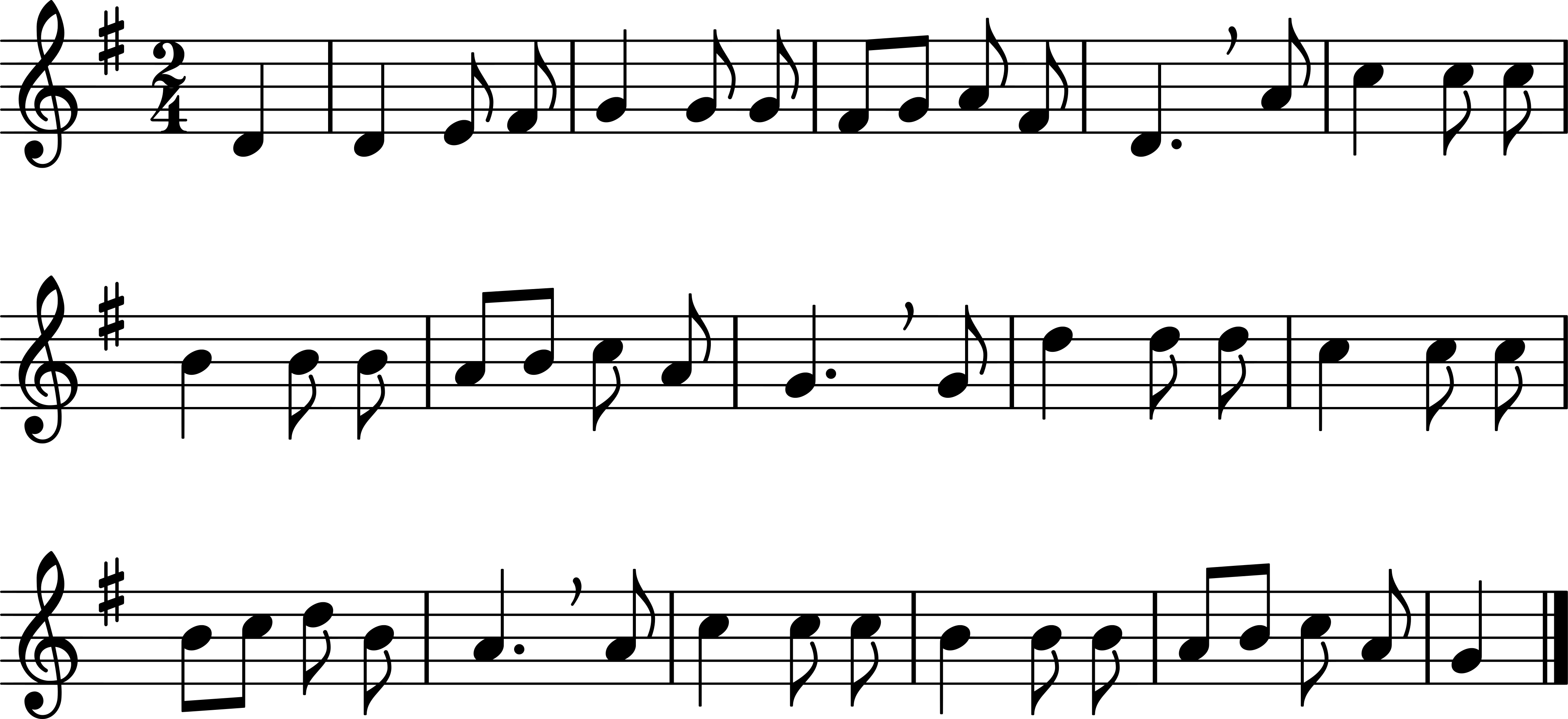
a Roman Catholic parish here in Berlin. It intrigued me because of the
references to an <i lang=de>englische Hand</i> and <i lang=de>englischer
Schritt</i> which, I realized only weeks later, are to do with angels
(<i lang=de>Engel</i>) and not with England. (I was quite puzzled that
18th century German-speaking Roman Catholics in modern-day France would
have praised English artists and English bravery in a Marian hymn!)</p>
<figure>
<img src="/img/schoenste.svg" style="width:100%">
</figure>
<ol type="1">
<li><p>How lovely the maiden in royal array,<br />
such splendour above any angel’s display!<br />
His angel God sent to show Mary her call:<br />
for beauty in faithfulness chosen of all.</p></li>
<li><p>Her head now adornèd with bright golden crown,<br />
the sceptre she leadeth before her Son’s throne:<br />
So bravely our heavenly heroine tread<br />
and trampled the demonic serpent’s vile head.</p></li>
<li><p>O Virgin of virgins in holy embrace,<br />
O radient with virtue, resplendent with grace:<br />
The stars and the sun deck thy visage with light;<br />
the heavenly company joys at thy sight.</p></li>
<li><p>No star in the sky nor no flower below,<br />
no sunlight so glorious as thy saintly glow;<br />
the roses will wither, the stars one day fade,<br />
but thou art in beauty forever displayed.</p></li>
</ol>
<hr />
<ol type="1">
<li><p><i lang=de> Die Schönste von allen, von fürstlichem Stand,<br />
kann Schön’res nicht malen ein’ englische Hand:<br />
Maria mit Namen, an ihrer Gestalt<br />
all Schönheit beisammen Gott selbst wohlgefallt.</i></p></li>
<li><p><i lang=de> Ihr Haupt ist gezieret mit goldener Kron’,<br />
das Zepter sie führet am himmlischen Thron,<br />
ein’ sehr starke Heldin, mit englischem Schritt<br />
der höllischen Schlange den Kopf sie zertritt.</i></p></li>
<li><p><i lang=de> Wohlan denn, o Jungfrau, der Jungfrauen Bild,<br />
von Tugenden strahlend, mit Gnaden erfüllt,<br />
mit Sternen geschmücket, die Sonne dich kleidt,<br />
die Engel, den Himmel dein Anblick erfreut!</i></p></li>
<li><p><i lang=de> Die Sterne verlöschen; die Sonn’, die jetzt
brennt,<br />
wird einstens verdunkeln, und alles sich endt;<br />
du aber wirst strahlen noch lang nach der Zeit<br />
in himmlischer Glorie durch all’ Ewigkeit.</i><a href="#fn1"
class="footnote-ref" id="fnref1"
role="doc-noteref"><sup>1</sup></a></p></li>
</ol>
<section id="footnotes" class="footnotes footnotes-end-of-document"
role="doc-endnotes">
<hr />
<ol>
<li id="fn1"><p>My translation is based on an alternative fourth verse
which you can <a
href="https://www.volksliederarchiv.de/die-schoenste-von-allen-von-fuerstlichem-stand/">read
at Volksliederarchiv.de.</a><a href="#fnref1" class="footnote-back"
role="doc-backlink">↩︎</a></p></li>
</ol>
</section>]]></content><author><name>Daphne Preston-Kendal</name></author><summary type="html"><![CDATA[I encountered this Lorrainian folk hymn to Mary on a recent visit to a Roman Catholic parish here in Berlin. It intrigued me because of the references to an englische Hand and englischer Schritt which, I realized only weeks later, are to do with angels (Engel) and not with England. (I was quite puzzled that 18th century German-speaking Roman Catholics in modern-day France would have praised English artists and English bravery in a Marian hymn!)]]></summary></entry><entry><title type="html">With hearty repentance and true faith</title><link href="https://inthefourthnocturn.de/2020/01/hearty-repentance/" rel="alternate" type="text/html" title="With hearty repentance and true faith" /><published>2020-01-03T11:12:33+00:00</published><updated>2020-01-03T11:12:33+00:00</updated><id>https://inthefourthnocturn.de/2020/01/hearty-repentance</id><content type="html" xml:base="https://inthefourthnocturn.de/2020/01/hearty-repentance/"><![CDATA[<p><a href="/2020/01/draw-near/">According to the rubrics,</a> the
disjointed elements of the second part of the <cite>Book of Common
Prayer</cite> communion service are united and distinguished from the
rest of the service by the communicants’ position, ready in a convenient
place to receive the holy commnion from the confession of sin onwards.
The significance of the integration of the confession of sin so closely
into the rite of communion is obvious when pointed out: confession of
sin and reception of the communion are intimately linked with one
another, the holy body and blood received sealing recipients’ penitence
and washing away their sins acknowledged.</p>
<p>Most modern Anglican liturgies, especially <cite>Common
Worship</cite> Order One, move the confession and absolution at the holy
communion service from its traditional Anglican place within the
communion rite — either (in England and America) immediately before the
eucharistic prayer proper, or (in Scotland as in the first prayer book)
after the consecration and immediately before reception — to the very
beginning of the service. The historical and ecumenical logic is
impeccable: it takes the place of the <i lang=la>confiteor</i> of the
old mass; it matches the placement of the confession at the prayer
book’s daily office; it is where the ‘act of penitence’ is in the modern
Roman mass.</p>
<p>Unfortunately, though, it destroys the immediate combination of
penitence and celebration in the eucharist which has been with Anglicans
since before our first fully reformed liturgy.<a href="#fn1"
class="footnote-ref" id="fnref1" role="doc-noteref"><sup>1</sup></a>
This combination is striking: while we celebrate Christ, the sinless and
utterly innocent man, dying a criminal’s death to save us, we also see
the immediate contrast to ourselves, constantly in need of his infinite
forgiveness to save our souls. True, the modern liturgies provide other
ways of emphasizing this contrast, such as the prayer of humble access
(or the Roman import <i lang=la>Domine, non sum dignus</i>), but are
generally optional — and none can be so meaningful as the promise of
forgiveness in the priest’s declaration of absolution followed by that
promise’s seal in the sacrament mere moments later.</p>
<p>Further, placing the confession and absolution that creates an
impression that penitence, rather than being an integral part of the
remembrance of Christ in the eucharist (and of the ideals of Christian
living which the eucharistic memorial represents), is something to get
out of the way as quickly as possible before moving onto other things.
It fails to put repentance at the centre of the Christian message; when
combined with invitations to the altar such as ‘all are welcome’, it
robs the sacrament of its penitential context entirely.</p>
<section id="footnotes" class="footnotes footnotes-end-of-document"
role="doc-endnotes">
<hr />
<ol>
<li id="fn1"><p>The 1548 interim <a
href="http://justus.anglican.org/resources/bcp/Communion_1548.htm">‘Order
of the Communion’,</a> providing for the ministration of communion in
English within the old Latin mass, had the confession in the same place
as it ended up in the 1549 prayer book.<a href="#fnref1"
class="footnote-back" role="doc-backlink">↩︎</a></p></li>
</ol>
</section>]]></content><author><name>Daphne Preston-Kendal</name></author><summary type="html"><![CDATA[According to the rubrics, the disjointed elements of the second part of the Book of Common Prayer communion service are united and distinguished from the rest of the service by the communicants’ position, ready in a convenient place to receive the holy commnion from the confession of sin onwards. The significance of the integration of the confession of sin so closely into the rite of communion is obvious when pointed out: confession of sin and reception of the communion are intimately linked with one another, the holy body and blood received sealing recipients’ penitence and washing away their sins acknowledged.]]></summary></entry><entry><title type="html">What’s in a rubric?: Draw near</title><link href="https://inthefourthnocturn.de/2020/01/draw-near/" rel="alternate" type="text/html" title="What’s in a rubric?: Draw near" /><published>2020-01-01T18:06:30+00:00</published><updated>2020-01-01T18:06:30+00:00</updated><id>https://inthefourthnocturn.de/2020/01/draw-near</id><content type="html" xml:base="https://inthefourthnocturn.de/2020/01/draw-near/"><![CDATA[<p>At a <a
href="https://www.eskimo.com/~lhowell/bcp1662/communion/index.html">communion
service according to the <cite>Book of Common Prayer,</cite></a> when
are the communicants supposed to enter the chancel and approach the
communion table to receive the sacrament?</p>
<p>In practice, the answer now (apparently for the last several
centuries) is after the ‘Prayer of Consecration’ (i.e. after the words
‘… as oft as ye shall drink it, in remembrance of me. Amen.’) But the
text of the rubrics of the 1662 <cite>BCP</cite> seem to at least
accommodate, even to <em>direct,</em> a different, older practice.</p>
<p>The rubric before the third <a
href="/2019/03/frequent-communion/">exhortation</a> (‘at the time of the
Celebration of the Communion’) directs that the exhortation should be
read with ‘the Communicants being conveniently placed for the receiving
of the holy Sacrament’. This implies that e.g. if the communicants are
to receive the sacrament kneeling at a communion rail (as the Laudian
authors of this rubric doubtless hoped), they should already be there
for the exhortation, and remain there throughout the confession,
preface, humble access, and institution narrative.</p>
<h1 id="obiter-dictum-the-reading-of-the-exhortations">Obiter dictum:
The reading of the exhortations</h1>
<p>All three exhortations are printed in the communion service between
the prayer for Christ’s Church and the confession, but only the third is
to actually be read at that point. The rubric before the first
exhortation, covering also the second, directs that those exhortations
should be read ‘after the Sermon or Homily ended’. This was a change
from the practice in the 1552–1604 prayer books, which clearly directed
all of the exhortation to be read (one after the other!) after the
prayer for the Church. The Laudian/episcopalian party involved in the
revision of the prayer book in 1662, from early on in their thinking,
saw that the exhortations were more of the nature of a sermon than a
prayer and therefore should be read in the pulpit, not from the chancel.
Bishop Matthew Wren’s <cite>Advices,</cite> containing his own notes on
his proposals for revision, suggests that the rubric begin</p>
<blockquote>
<p>Warning shall be duly given for every Communion, by the Minister,
upon the Sunday before, next after the Nicen Creed at Morning Prayer
[…]<a href="#fn1" class="footnote-ref" id="fnref1"
role="doc-noteref"><sup>1</sup></a></p>
</blockquote>
<p>(i.e. just <em>before</em> the sermon), and a proposed revision in
the Durham Book (the episcopal party’s early attempt at a draft proposed
prayer book combining all their wishes) read (emphasis mine)</p>
<blockquote>
<p>When the Curate shall see the people negligent to come to the holy
Communion, he shall use this Exhortation <em>in the pulpit after the
Sermon or Homilie there ended,</em> upon ye Sunday or some Holyday
before he intendeth to celebrate ye same.</p>
</blockquote>
<h1 id="the-time-of-approach">The time of approach</h1>
<p>At services with communion, then, by the reading of the third
exhortation,<a href="#fn2" class="footnote-ref" id="fnref2"
role="doc-noteref"><sup>2</sup></a> the communicants should already be
placed for receiving the consecrated bread and wine. But when should
they actually have moved from their seats in the nave to this
position?</p>
<p>The 1549 prayer book had an explicit rubric to this effect, directing
that, at the offertory,</p>
<blockquote>
<p>so many as are disposed, shall offer unto the poore mennes boxe every
one accordynge to his habilitie and charitable mynde. […]</p>
<p>Then so manye as shalbe partakers of the holy Communion, shall tary
still in the quire, or in some convenient place nigh the quire, the men
on the one side, and the women on the other syde. All other (that mynde
not to receive the said holy Communion) shall departe out of the quire,
except the ministers and Clerkes.</p>
</blockquote>
<p>The expectation was, then, that the poor box would be somewhere in
the chancel<a href="#fn3" class="footnote-ref" id="fnref3"
role="doc-noteref"><sup>3</sup></a> and parishioners would approach it
at the offertory to put their money in, and remain (‘tarry still’) there
if they wanted to communicate, otherwise returning to their places in
the nave.</p>
<p>In 1552 though, this rubric was gone and, though the poor box
remained, it was to be approached only by the churchwardens (‘or some
other by them appointed’) after gathering the offerings of the people,
more like a modern offertory collection.<a href="#fn4"
class="footnote-ref" id="fnref4" role="doc-noteref"><sup>4</sup></a></p>
<p>The <cite>BCP</cite> editions from 1552 to 1604 contain no direction
at all for when the communicants would approach the altar, but
presumably the intention was to maintain something like the 1549
practice. But with the offering of money now done by the churchwardens
on behalf of the people, were they then expected to enter the chancel
after the offertory having remained in their seats for the collection?
Or after the prayer for Christ’s Church? Or, more confusingly, following
the direction of the priest when he told them to ‘draw near with
faith’?</p>
<p>There remains also a third option, that the intending communicants
should be in the quire from the start of the service ready to receive.
But this can be ruled out on various grounds: in most churches, this
would mean the communicants would be sitting <em>behind</em> the pulpit
during the sermon; the gathering of people in the quire, assuming they
did not sit in the stalls (which would be occupied by choristers in
large churches), would inconveniently block the way of the priest on the
way to the pulpit and lectern; and if it were done that way, there would
be no need for the rubric asking people to give notice of their
intention to communicate for the priest so he may know how many will
receive with him, since he could see them in the chancel at the start of
the service.</p>
<p>In 1549 the words ‘draw near with faith’ followed the consecration,
with the communicants having already been in the quire since the
offertory, and so the ‘drawing near’ was most certainly in a spiritual,
not a literal sense. Further, we have already seen that the 1662 book’s
authors intended the communicants to be in place before this point. To
this end several of the bishops’ proposals in 1662 suggested deleting
the ‘draw near’ language from that short preface to the confession to
avoid confusion, including Wren’s <cite>Advices</cite> and John Cosin’s
<cite>Particulars</cite>. So the ‘draw near with faith’ point for
entering the chancel can likewise be ruled out: the people should
already physically be in place by that point.</p>
<p>Ruling out either the offertory or the exhortation as the time at
which communicants should approach is considerably less clear-cut.
Essentially, the only evidence within the 1662 book or any of the drafts
of it that I can find is that final form of the rubric for the third
exhortation, ‘the Communicants being conveniently placed for the
receiving of the holy Sacrament’. But even this is unclear: the passive
language used suggests that by the time of the reading of the third
exhortation, the people should <em>already</em> be so ‘conveniently
placed’. This may <em>suggest</em> an earlier approach to the altar,
before the prayer for the whole state of Christ’s Church (which, in
1549, followed the <i lang=la>Sanctus</i> and therefore was also prayed
with the communicants in the quire prepared to receive), but does not
give a clear indication.</p>
<p>In the absence of any clear rubric, it is difficult to know which of
these two positions the approach should have. Nor is it easy to appeal
to any precedent other than 1549, because the question depends on the
complicated nature of the prayer for Christ’s Church. In terms of
liturgical history, the prayer for the Church fills three distinct rôles
at once: as the first part of the prayer book’s ‘disjointed canon’, in
which case it is part of the communion rite and the people should be
appropriately placed for it; as the reformers’ reintroduction of the
ancient <i lang=la>oratio fidelium,</i> in which case it is part of the
‘pro-mass’ and not the communion itself,<a href="#fn5"
class="footnote-ref" id="fnref5" role="doc-noteref"><sup>5</sup></a> and
should be said in the same place as the rest of that part of the
service, i.e. the nave; and as an offertory prayer replacing the
mediaeval <i lang=la>secreta,</i> in which case it has an ambiguous
position between the two possibilities.<a href="#fn6"
class="footnote-ref" id="fnref6" role="doc-noteref"><sup>6</sup></a></p>
<p>For an abundance of caution, I would suggest the approach to be
<em>after</em> the prayer for the Church, since that is the only point
at which a rubric explicitly mentions the people’s placement to receive
the sacrament. Nonetheless the reformers’ intentions were clear: that
the intending communicants should be in their places to receive the
sacrament throughout the whole eucharistic prayer, even including the
confession, and thereby to create an integrated communion rite in which
the people were present in the chancel for the whole act of penitence,
celebration, reception, and thanksgiving — despite having apparently
‘disjointed’ the canon of the mass into multiple scattered pieces. While
numbers of communicants are now generally too large, and churches too
small, for so many to be crowded into the quire for so long, it’s worth
considering how the intended posture for the entire second half of the
1662 communion service at the time held the catholicity of the service
together despite the arrangement of its elements having been much
criticized.<a href="#fn7" class="footnote-ref" id="fnref7"
role="doc-noteref"><sup>7</sup></a></p>
<hr />
<p><strong>Update:</strong> I later found <a
href="/2020/01/approach-18c/">more evidence</a> on this question.</p>
<section id="footnotes" class="footnotes footnotes-end-of-document"
role="doc-endnotes">
<hr />
<ol>
<li id="fn1"><p>‘Morning Prayer’ refers to the whole morning
<em>service</em> including the communion, and not merely to Mattins. The
same sense is apparently used in the 22nd canon of 1604: ‘we do require
every Minister to give Warning to his Parishioners publickly in the
Church at Morning Prayer, the Sunday before every time of his
administering that holy Sacrament, for their better preparation of
themselves’.<a href="#fnref1" class="footnote-back"
role="doc-backlink">↩︎</a></p></li>
<li id="fn2"><p>Or, if the exhortations have been omitted as is now
usual, by the time of reading ‘Ye that do truly …’<a href="#fnref2"
class="footnote-back" role="doc-backlink">↩︎</a></p></li>
<li id="fn3"><p>The Edwardian Injunctions of 1547 instructed that the
poor box should be placed ‘near unto the high altar’.<a href="#fnref3"
class="footnote-back" role="doc-backlink">↩︎</a></p></li>
<li id="fn4"><p>1662 removed all mention of the poor box and introduced
the modern practice of placing the collected money on the altar,
apparently because many churches no longer had poor boxes anyway by that
time.<a href="#fnref4" class="footnote-back"
role="doc-backlink">↩︎</a></p></li>
<li id="fn5"><p>The ancient intercessions were said before the
offertory.<a href="#fnref5" class="footnote-back"
role="doc-backlink">↩︎</a></p></li>
<li id="fn6"><p>One of the better suggestions made in the first series
of <cite>Prayer Book Studies</cite> was that, if the Litany had been
said before the Holy Communion, the prayer for Christ’s Church ought to
serve as a pure offertory prayer — by skipping straight from ‘godly
love’ to the closing ‘grant this’. The reason for this is that the
Litany at the start of the service is another form of <i lang=la>oratio
fidelium,</i> of which only one instance is needed per service.<a
href="#fnref6" class="footnote-back" role="doc-backlink">↩︎</a></p></li>
<li id="fn7"><p>Even by the Laudians writing the 1662 book, who tried
and failed to get a form of the 1549 prayer of consecration, with
anamnesis and oblation paragraphs restored, past the Puritan party.<a
href="#fnref7" class="footnote-back" role="doc-backlink">↩︎</a></p></li>
</ol>
</section>]]></content><author><name>Daphne Preston-Kendal</name></author><summary type="html"><![CDATA[At a communion service according to the Book of Common Prayer, when are the communicants supposed to enter the chancel and approach the communion table to receive the sacrament?]]></summary></entry><entry><title type="html">The Father Christmas problem</title><link href="https://inthefourthnocturn.de/2019/12/christmas-problem/" rel="alternate" type="text/html" title="The Father Christmas problem" /><published>2019-12-25T19:58:01+00:00</published><updated>2019-12-25T19:58:01+00:00</updated><id>https://inthefourthnocturn.de/2019/12/christmas-problem</id><content type="html" xml:base="https://inthefourthnocturn.de/2019/12/christmas-problem/"><![CDATA[<p>Why should children continue to believe in God after they stop
believing in Father Christmas?</p>
<p>Children’s worlds are full of supernatural gift-givers: Father
Christmas (Santa Claus), the Easter bunny, the tooth fairy. These
one-dimensional characters dispensing worldly pleasures are people whom
children are expected to grow out of believing in.</p>
<p>At a certain age, children become natural skeptics, beginning to
question for themselves what their parents have told them about the
world: they begin to notice that Father Christmas’s handwriting and
wrapping paper is suspiciously similar to their parents’; the tooth
fairy doesn’t visit when they lose a tooth without telling anyone. When
these figures disappear from their lives, why shouldn’t God go with
them?</p>
<p>This is not a purely hypothetical question: <a
href="https://www.youtube.com/watch?v=jS71A13uyEo">children who discover
for themselves that the magical gift-givers aren’t real really do become
more skeptical about religion.</a><a href="#fn1" class="footnote-ref"
id="fnref1" role="doc-noteref"><sup>1</sup></a> Adults impose a certain
amount of social pressure — having an adult in their life who is clearly
actively a faithful Christian certainly <em>implies</em> that belief in
God is for adults as well as children — but retention rates in the
Church from childhood into adulthood suggest this is far too little, too
late.</p>
<p>God, of course, is far more than these childhood characters ever
claim to be: Father Christmas brings toys; God gives life and death,
incarnation and resurrection, creation and apocalypse. Children’s church
and Sunday school are good at teaching young children Bible stories.
Young children will believe their literal truth; a deeper understanding
of their actual spiritual meaning is presumed to follow at later
ages.</p>
<p>But how? What do we actually offer for slightly older children, with
their newly-developed pseudo-scientific view of the world, losing their
childhood sense of magic? And the even older ones who are learning about
geology, evolution, and the incredible vastness of the universe in their
school classes, and need to understand how God fits into all of it? Are
confirmation classes not too little, too late, even where they are
offered?</p>
<section id="footnotes" class="footnotes footnotes-end-of-document"
role="doc-endnotes">
<hr />
<ol>
<li id="fn1"><p>Apologies for linking a YouTube video and not the
original study, but the paper itself is paywalled; further, Rebecca
Watson is wonderful and deserves more attention, and, though I obviously
entirely disagree with her about religion, her perspective and reaction
as a non-Christian is telling.<a href="#fnref1" class="footnote-back"
role="doc-backlink">↩︎</a></p></li>
</ol>
</section>]]></content><author><name>Daphne Preston-Kendal</name></author><summary type="html"><![CDATA[Why should children continue to believe in God after they stop believing in Father Christmas?]]></summary></entry></feed>